2 / 15
L'Escapade Bohème
The project
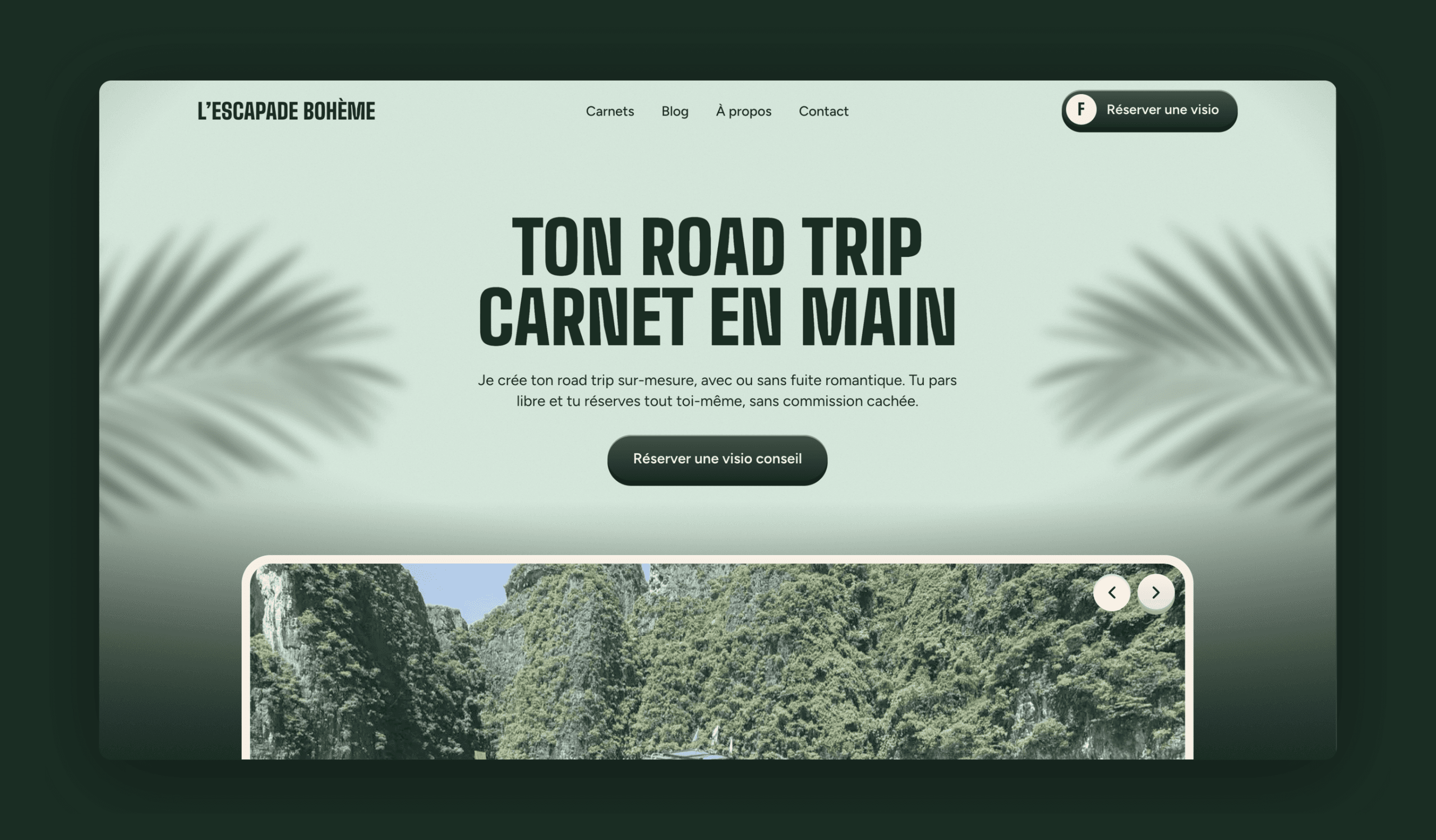
Fanny started L'Escapade Bohème after planning her own elopement: agencies were asking prices that put the dream out of reach. She builds itineraries on routes she has tested herself, and her travellers set off fully independent with their road book.
The site had to make people want to leave, explain the two offers clearly (the tailor-made road book and the advice video call), and lead to a booking. Behind it, Fanny needed a simple tool to follow her clients without exposing their data.
- destination palettes, on top of the house palette
- 3
- tabs in Fanny's back office
- 6
- client file stages, from request to archive
- 10
- client data stored in the CMS
- 0
An identity that changes country
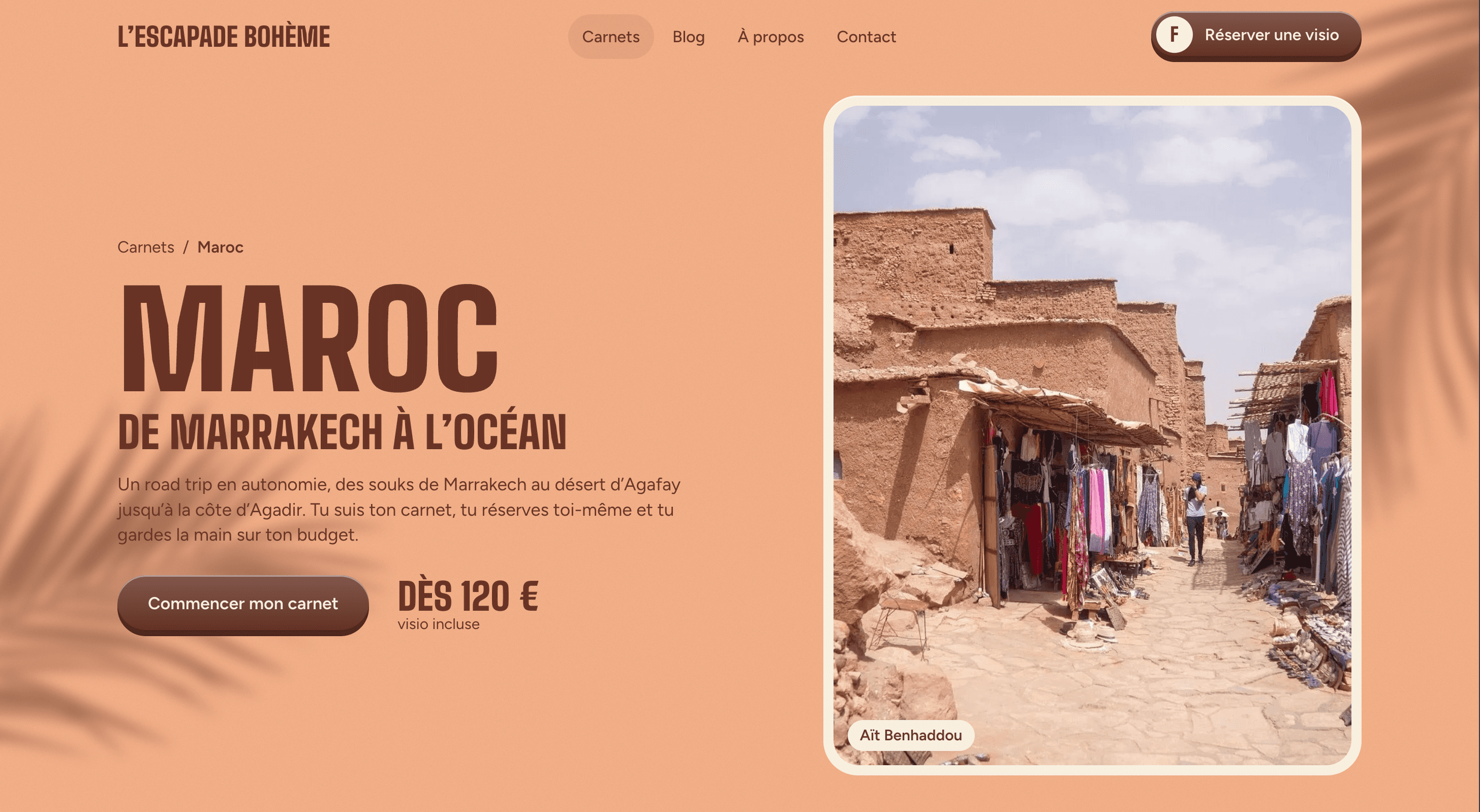
I built the brand guidelines around a house palette and one palette per destination: Thailand, Morocco, Martinique. Each road book takes on its country's colours, injected as CSS variables and editable by Fanny in the Studio.
Headings are set in Big Shoulders Display, body text in Figtree, handwritten notes in Covered By Your Grace, and each destination has its local script (Sriracha for Thai, Aref Ruqaa for Arabic). The visual system comes down to a few materials: blurred plants, grain, rounded leaves, and raised buttons that press down on click.
The UX borrows from travel objects: the About page is a passport, the contact page a postcard, and a plane transition plays when a road book opens.
A site Fanny runs on her own
The Sanity Studio is built into the site. Fanny manages her destinations there (published, coming soon or draft, with a preview before publishing), the copy of every page, the legal pages, the blog, its authors and its categories. If a field is emptied, the site falls back to the original copy, so a page never shows a gap.
For each road book map, Fanny enters the country and the cities. The route is computed on the server from Natural Earth data and the stops place themselves. Each publication refreshes only the pages concerned, through tag-based revalidation.
A back office built around her job
The custom admin follows a client's real journey: request received, meeting booked, call done, road book in progress, road book delivered, trip, review, archive. The Today screen lists what needs doing: new requests, today's meetings, calls to invoice. Each client file has a single main action, the one for its current stage.
Meetings come in from Cal.com through a signed webhook and attach to the right file. The PDF road book goes into private storage, then reaches the client through a personal, time-limited link. Files, Calendar, Invoices, Clients and Road books tabs complete the set, and it all works on a phone.
The CMS only holds what is meant to be public. No client data stays there.
Travellers' data kept safe
Clients live in a private Postgres database in Europe, never readable from the browser. Email, phone and notes are encrypted with AES-256-GCM, with an HMAC fingerprint to match a meeting without decrypting anything.
Sign-in goes through Clerk with Google, and a closed list of addresses is checked in every server action. On top of that: security headers (CSP, HSTS), an access log free of personal data, one-click export and deletion of a client, and an automatic nightly purge based on retention periods.
SEO planned from day one
Every page has its own title, description, canonical URL and share image, generated in the page's art direction with the brand typefaces. Google gets structured data: the travel agency, the breadcrumb trail and the blog articles. The sitemap and robots file are built from the published content.
Credits
- Art direction & brand guidelines
- William Ulses
- UX/UI design
- William Ulses
- Full-stack development & back office
- William Ulses
- SEO
- William Ulses
- Client
- Fanny, L'Escapade Bohème